La Ribera Starts Construction of Its Clubhouse and Moves Towards Consolidating the Neighborhood

The groundbreaking marks the beginning of one of the central pieces of the development and reinforces the materialization of a residential neighborhood conceived around water, safety and quality of life.
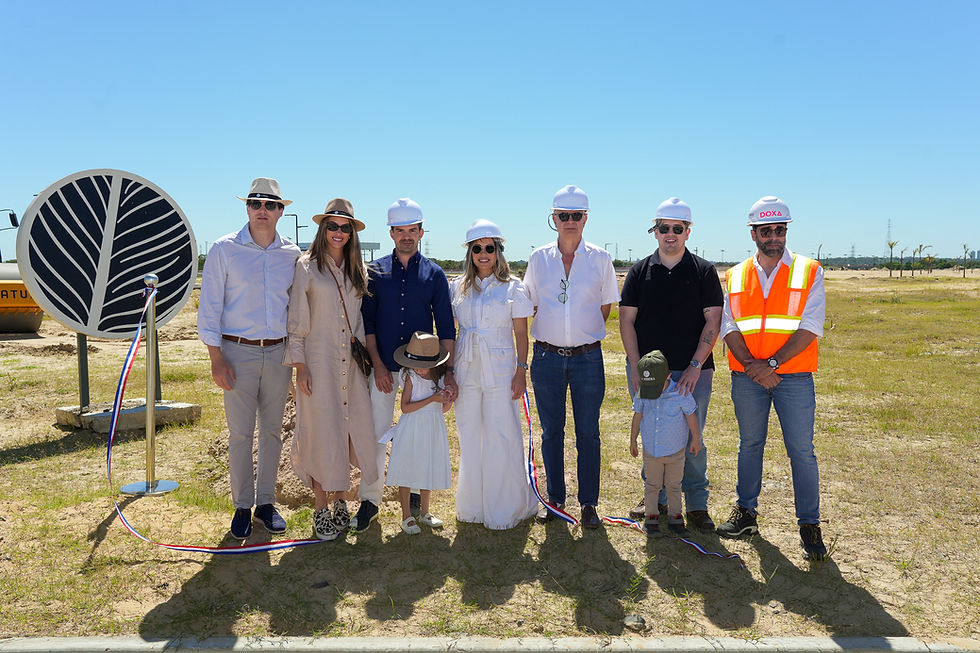
On Wednesday, December 17th, La Ribera broke ground on its Clubhouse, marking the formal start of one of the development's central elements. The commencement of this project solidifies the definitive transition from a blueprint to a living urban reality, reinforcing the progressive realization of a gated community designed around quality of life, security, landscape, and the everyday connection with water.
Located on the banks of the Pajaguá stream, with a direct connection to the Paraguay River, La Ribera offers a unique way of living: a residential environment that combines easy access to the city with a daily experience connected to water, green spaces, and personal time. This geographical location, along with its direct integration into Asunción's main road network via the Héroes del Chaco Bridge, is one of the project's key conceptual pillars.

The groundbreaking ceremony for the Club House represents much more than the start of a specific project. It symbolizes the consolidation of the neighborhood's social heart, a space designed as a meeting point, a place for enjoyment and community life, aligned with internationally recognized design and wellness standards.
From its inception, La Ribera was designed as a 100% residential neighborhood, without internal commercial areas, prioritizing tranquility, security, and a daily experience focused on family life. The project is developed within a completely walled perimeter, reinforced by a 20-meter setback from the property lines, designed to protect the community's connection with the immediate surroundings and enhance privacy.
The security system integrates continuous surveillance, cameras distributed throughout the neighborhood, access control using PCG and QR technology, and a monitoring station with six continuously operating screens. This infrastructure not only aims to prevent crime but also to generate a constant sense of control and predictability, one of the project's core values.
The resident experience begins upon entering. A grand entrance gate, internal streets surrounded by greenery, and the absence of individual walls in front of the homes create a clean, open, and cohesive urban landscape. The neighborhood's design incorporates more than eight kilometers of internal pathways intended for walking, jogging, or cycling in a safe environment, promoting an active, outdoor lifestyle.
The relationship with water is one of the project's fundamental principles. La Ribera is structured around a system of internal lagoons and the Pajaguá stream, offering uninterrupted water views from most lots. This connection is not merely scenic: it enables an everyday experience where activities such as recreational boating, contemplating the landscape, or simply visually connecting with the water become part of daily life.
In terms of scale, La Ribera envisions approximately 350 homes distributed across city blocks, which will be delivered progressively. Block A has already been delivered, Block B is scheduled for February, and the timeline will continue with Blocks C, D, and so on until Block K is completed. Meanwhile, construction is already underway on other homes, with plans for further development, reinforcing the project's transition to a vibrant and active community.
The neighborhood was conceived as an integrated infrastructure system, designed to operate self-sufficiently. It features a wastewater treatment plant, a reverse osmosis drinking water plant with quality standards comparable to bottled water, and an electrical generation system capable of meeting 100% of the neighborhood's demand in the event of public utility outages. This approach eliminates the need for individual solutions, prevents the proliferation of visible generators, and reinforces a well-ordered urban aesthetic.
The new Clubhouse, whose construction has just begun, will have a total covered area of 1,500 m², distributed as follows: 900 m² on the ground floor and 600 m² on the upper floor. In addition, there are 130 m² of semi-covered space on the ground floor and 360 m² of terraces on the upper floor. The program includes a 200 m² event hall with an outdoor extension, with a capacity of approximately 200 people; a restaurant with 200 m² of covered space plus 150 m² of semi-covered space, with a total capacity of approximately 180 people; and six individual barbecue areas, each with 90 m² of covered space and 60 m² of terrace.
The Clubhouse grounds are complemented by a 3,600 m² saltwater lagoon, accompanied by a 2,000 m² beach and a beach bar, reinforcing the recreational and social character of the space. The project has an estimated completion time of one year, and construction of the second Clubhouse is expected to begin around the same time next year.
This second clubhouse will be focused on sports and physical well-being. It will have an approximate area of 2,000 m² and will include a new events hall, restaurant, a 450 m² gym, spa areas, sauna, and hair salon. In its immediate vicinity, a sports complex will be developed with four tennis courts, four paddle tennis courts, two basketball courts, three volleyball courts, and a soccer field, integrated with one of the largest residential lagoons in the neighborhood.
In total, the amenities occupy approximately three hectares within the 60 total hectares of the project, one of the main differentiators in terms of well-being and daily use of the space.
Currently, there are around 180 lots available, with areas ranging from 450 m² to 3,000 m², and prices starting from approximately $120,000.
The concept for La Ribera is deeply rooted in architecture and urban planning. It arose from a long-standing quest to develop a gated community that wouldn't sacrifice urban proximity or quality of life, combining the spatial quality of a planned environment with the immediacy of the city. After years of exploring different sites and more than 40 preliminary designs, the final location was secured following the dredging work related to the road infrastructure in the area of the Puente Héroes del Chaco (Heroes of Chaco Bridge), where a plot of land with exceptional conditions was identified.

Signature is acting as the project's full-service developer, handling both real estate development and earthmoving and land reclamation. Larger-scale civil works, such as the entrance gate and the clubhouse, are being carried out by Doxa, while the urban and architectural design of the gated community and the clubhouses was developed by PATH URBAN, a Buenos Aires-based studio specializing in high-quality urban and architectural design, with a focus on sustainability, integration between city and nature, and construction efficiency.
On the financial front, Valores Casa de Bolsa is supporting the project as organizer and structurer, contributing over 30 years of experience in financial solutions. Through its Real Estate division, it joins as a strategic partner, providing solid institutional backing that reinforces the project's confidence and stability.
The groundbreaking ceremony for the Clubhouse marks a turning point for La Ribera. It not only confirms the project's physical progress but also solidifies a residential concept that reinterprets the relationship between city, water, and quality of life. At a time when Asunción is beginning to revalue its connection to its water system, La Ribera positions itself as one of the developments that best translates this transformation into a concrete way of living.
Those interested in learning more about La Ribera and the available residential opportunities can complete the form at the end of this article. The project team will then contact you directly to offer advice and details tailored to your specific inquiry.


